
Quick answer: The time to book Korea cherry blossom group tours for spring 2027 is now — nine months ahead. Blossom-window hotels in Seoul, Busan and Gyeongju and licensed coaches are the first inventory to sell out, typically by late autumn 2026. The 2027 bloom front runs south to north: Jeju in late March, Busan and Jinhae late March to early April, Gyeongju in early April, Seoul early to mid April. Agents who contract early lock net rates before peak-season surcharges apply, secure allotments and keep free date-change windows — the single most effective hedge against a shifting bloom.
Why 2027 cherry blossom groups must be contracted in 2026
Cherry blossom season is the most compressed demand spike in the Korean travel calendar. Roughly three weeks of bloom absorb a full quarter's worth of inbound group traffic, layered on top of domestic travellers, school holidays in several source markets and the Jinhae festival's own million-plus visitors. The consequence for the trade is simple: the inventory that group programmes depend on disappears earliest.
- Hotels go first. Group-friendly four-star blocks in Seoul, Busan and Gyeongju for the first two weeks of April are historically the tightest room-nights of the year. Serious series operators finalise blossom blocks 9–12 months out; by January the remaining inventory typically carries peak-season surcharges.
- Coaches go second. Korea's licensed tourist-coach fleet is finite, and blossom week coincides with domestic corporate outings and school excursions. Vehicles with certified drivers for Jinhae festival days are routinely gone by December.
- Rail follows. KTX group quotas on the Seoul–Busan and Seoul–Gyeongju corridors open later, but the favourable morning departures that make a blossom-chase itinerary work are limited per train.
- Guides last — but not least. Licensed guides in Spanish, French, German and Portuguese are a scarce resource in any season; in blossom weeks they are the difference between confirming a series and declining it.
Booking in July–October 2026 is therefore not a promotional slogan — it is the operational window in which a DMC can still guarantee all four layers at contracted net rates.
The 2027 bloom forecast, band by band
Korea's bloom front moves south to north over roughly three weeks. Exact dates firm up when the Korea Meteorological Administration issues its first forecast in early March 2027, but the historical bands are stable enough to plan and contract against today:
- Jeju Island — late March. First full bloom in the country, usually between 22 and 31 March. King cherry trees (the largest blossoms of any variety) line Jeonnong-ro in Jeju City and the Noksan-ro rapeseed-and-cherry road.
- Busan & Jinhae — late March to early April. Full bloom typically 27 March–5 April. The Jinhae Gunhangje Festival is scheduled around this window, and Busan's Dalmaji Hill and Nakdong riverside bloom in parallel.
- Gyeongju — early April. Usually 1–8 April. Bomun Lake and the tumuli parkland bloom together — heritage plus blossoms in one compact destination.
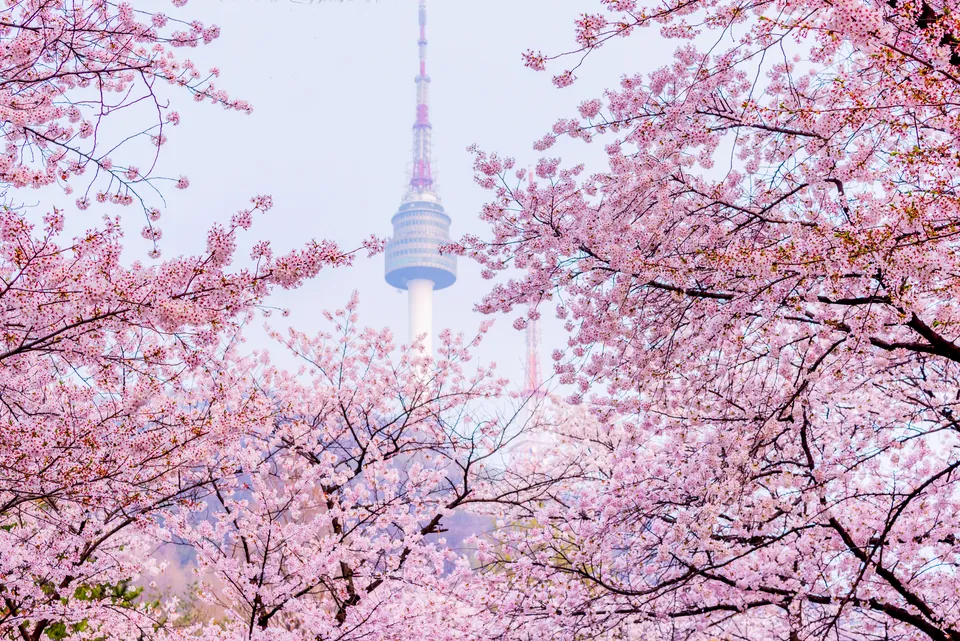
- Seoul — early to mid April. Full bloom generally 5–15 April at Yeouido, Seokchon Lake and the palace quarter.
The professional way to sell this is date-flexible itinerary design: build the programme so that each region is visited inside its band, and structure the middle days so the coach can pivot 100–200 km north or south without changing hotels more than once. A south-to-north routing gives the group two, sometimes three chances to stand under full bloom even if any single city peaks early or late.
Signature blossom spots — and how to manage crowds with a group
Jinhae Gunhangje Festival — the flagship
Jinhae, a naval town 40 minutes west of Busan, hosts Korea's largest cherry blossom festival: some 350,000 trees, the Yeojwacheon stream walk and the railway crossing at Gyeonghwa Station where blossom tunnels frame the tracks. It is spectacular — and crowded. For groups, the tactics that work are: arrive before 08:00 for Gyeonghwa Station, walk Yeojwacheon before 10:00, park the coach at the designated festival lots and use a local shuttle, and never schedule Jinhae on the festival's first or middle weekend. Explera positions groups in Busan hotels and runs Jinhae as an early-start half day.
Seoul — Yeouido and Seokchon Lake
Yeouido's Yunjungno, behind the National Assembly, is the capital's classic blossom avenue — around 1,600 trees along the Han River. Seokchon Lake, beneath Lotte World Tower, offers a 2.5 km blossom loop with skyline photography. Both are extremely busy from late morning on festival days. Group tactics: 07:30 photo slots at Yeouido before the coach ban zones activate, weekday scheduling wherever possible, and evening visits to Seokchon Lake when the lanterns come on and day-trippers have left. Palace grounds (Changdeokgung, Gyeongbokgung) carry lighter blossom but absorb groups gracefully at any hour.
Gyeongju — Bomun Lake and the heritage belt
Gyeongju is the connoisseur's blossom stop: the Bomun Lake resort loop is ringed with mature cherries, and the trees among the Silla royal tumuli give photographs no other country can duplicate. Crowds are gentler than Jinhae or Seoul, coaches park easily at Bomun, and resort hotels sit directly on the blossom loop — which is why Gyeongju is the ideal mid-itinerary recovery night for a group that has just worked through festival crowds.
Jeju — blossom roads by coach
Jeju's king cherries bloom first and largest, and the island's blossom experience is built for vehicles: Jeonnong-ro in Jeju City, the Jeju National University avenue, and Noksan-ro where yellow rapeseed fields run beneath white blossom canopies. A coach can cover all three in a relaxed day with photo stops, making Jeju the lowest-stress opening chapter of a blossom programme — plus a weather hedge, since its bloom rarely fails even in a cold spring.
Sample 7-day south-to-north blossom chase (Jeju → Busan/Jinhae → Gyeongju → Seoul)
- Day 1 — Jeju arrival. Fly into Jeju International; afternoon Jeonnong-ro blossom walk and seafood dinner. Overnight Jeju City.
- Day 2 — Jeju blossom roads. Noksan-ro rapeseed-and-cherry drive, Hallim Park or Seongsan Ilchulbong; sunset at Aewol coast. Overnight Jeju City.
- Day 3 — Jeju → Busan. Morning flight to Gimhae; Dalmaji Hill blossoms, Haeundae Beach, Gamcheon Culture Village. Overnight Busan.
- Day 4 — Jinhae festival day. 06:30 departure; Gyeonghwa Station and Yeojwacheon stream before the crowds; afternoon recovery at Songdo cable car or Jagalchi market. Overnight Busan.
- Day 5 — Busan → Gyeongju. Coach transfer (75 min); Bomun Lake blossom loop, Bulguksa Temple, tumuli park at dusk. Overnight Bomun Lake resort.
- Day 6 — Gyeongju → Seoul by KTX. Morning Cheomseongdae photo stop; KTX from Singyeongju to Seoul (2h10); Seokchon Lake evening blossom walk. Overnight Seoul.
- Day 7 — Seoul blossom finale. 07:30 Yeouido Yunjungno slot, Gyeongbokgung in hanbok, Insadong; farewell dinner and departure transfer.
The routing follows the bloom front north, uses one internal flight and one KTX leg, and never repositions the group against the blossom calendar. It scales from 10 to 150 pax with parallel coaches.
Risk management: when the bloom shifts
Every third or fourth spring, bloom arrives 5–7 days early or late. A professionally built 2027 programme prices that risk in from the start:
- Bloom-shift contingency. Contract hotels with free date-change windows (Explera's early-booking blocks carry ±3-day flexibility until 60 days out) so a whole series can slide with the forecast after the March KMA update.
- Early-morning slots as standard. The first two hours of daylight are the only reliably uncrowded blossom hours at Jinhae, Yeouido and Seokchon. Build them into the programme rather than treating them as an optional extra.
- Mixed-programme insurance. Anchor each day with content that works rain-or-shine and bloom-or-no-bloom: palace circuits, Jagalchi and Gwangjang markets, the Songdo and Namsan cable cars, museums and hanbok experiences. If petals fall early, the day still delivers.
- South-north redundancy. The 7-day routing above means a cold spring (late bloom) still gives full bloom in Jeju and Jinhae, while a warm spring (early bloom) still delivers Seoul — the itinerary itself is the hedge.
Early-booking B2B net rates and Explera support
Explera DMC Korea is contracting spring 2027 blossom departures now, with the full ground stack under one agreement:
- Net rates locked before peak-season surcharges — hotel, coach, guide and entrance pricing contracted at 2026 levels for bookings confirmed by 31 October 2026
- Allotments in Seoul, Busan, Gyeongju and Jeju blossom-window hotels, held for partner agencies on a first-committed basis
- Free date-change windows of ±3 days on early-booked series, so programmes can follow the final KMA bloom forecast
- Licensed guides in English, Spanish, French, German, Portuguese, Arabic, Japanese, Chinese and Russian — reserved at contract, not at arrival
- KTX group quotas, internal flight blocks Jeju–Gimhae, festival coach permits for Jinhae and 24/7 operations support on every departure
IATA: 96215733 | Email: b2b@explera.kr | WhatsApp: +66 93 656 8090
Request a 2027 blossom quote at b2b.expleradmc.com or contact the trade desk — send your group size, preferred window (late March / early April / mid April) and source market, and our team responds within one business day with rates and allotment options.