
Quick answer: Korea is one of the strongest educational destinations an agent can pitch to a school: it is exceptionally safe, its public transport and digital infrastructure are world-class teaching material in themselves, and it lets one itinerary cover 5,000 years of history, frontier technology and the K-culture that students already love. What schools need from a DMC is equally clear — a 24/7 operations line, vetted youth-appropriate accommodation, licensed guides, documented chaperone ratios, dietary handling and the insurance paperwork school boards demand. Explera DMC Korea builds student programs around exactly that checklist, with B2B net rates, free teacher places and proposal kits agents can rebrand for the 2026-27 school year.
Why Korea works for student and educational groups
Student travel is the most compliance-driven segment in the group business — but it is also the most loyal. A school that runs one successful trip repeats it every year, often with the same agent, for a decade. Korea has quietly become one of the easiest destinations to win that first approval for:
- Safety that parents can verify — Korea consistently ranks among the safest countries in the world for street crime, public spaces are monitored and well-lit, and lost-property return rates are famous. For risk-assessment forms, this is the destination that writes its own answers.
- Technology as a living classroom — students see 5G everywhere, robot baristas, autonomous delivery and the corporate showrooms of the world's leading electronics and battery makers. A tech itinerary here is observation, not simulation.
- History with UNESCO depth — from Joseon-dynasty palaces in Seoul to the Silla-era capital of Gyeongju, Korea offers a continuous, walkable 5,000-year narrative that maps directly onto history and social-studies curricula.
- K-culture as the motivation engine — K-pop, K-drama and Korean food are what make students lobby their parents for this trip. The educational program supplies the justification; hallyu supplies the enthusiasm.
- University ambitions — for senior cohorts, campus visits to SNU, Yonsei and Korea University turn a school trip into a recruitment-relevant experience, a strong angle for international schools across Asia, the Gulf and beyond.
The four program pillars
History & heritage — Gyeongbokgung, Bukchon and Gyeongju
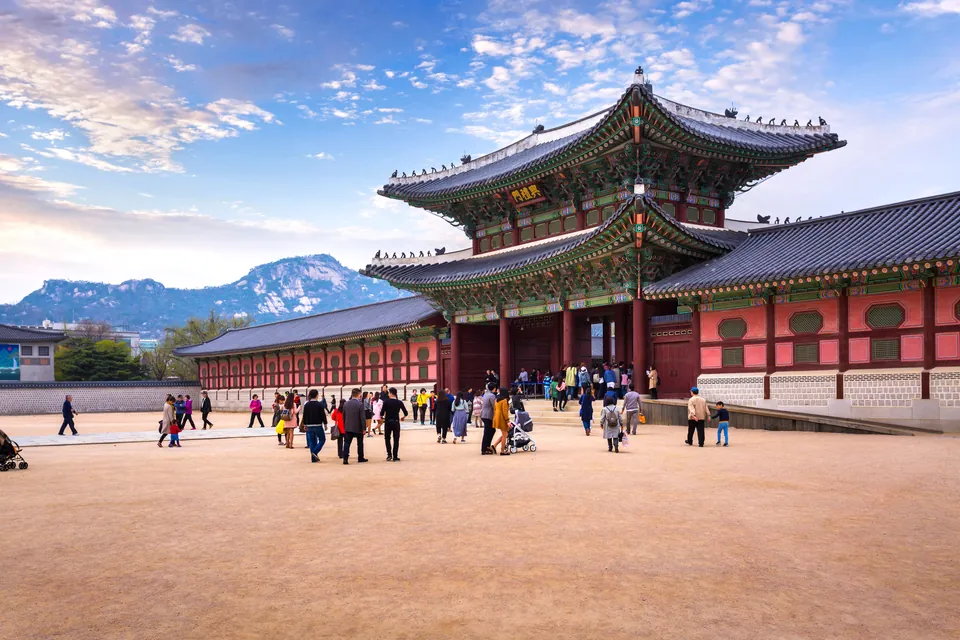
The heritage day in Seoul anchors every student itinerary: the changing of the guard at Gyeongbokgung Palace, a guided walk through Bukchon Hanok Village and the National Museum of Korea, whose free-entry galleries condense the entire peninsula's history into one afternoon. For deeper programs, add a KTX day or overnight to Gyeongju — Bulguksa Temple, the Tumuli royal burial mounds and Cheomseongdae observatory, East Asia's oldest surviving astronomical tower, give science and history teachers a shared lesson plan in a single park.
STEM & innovation — tech showcases, science museums and Digital Media City
Korea's STEM circuit is unmatched in Asia for group access. Corporate technology showcases in Gangnam and Suwon (Samsung d'light-style exhibition halls) demonstrate semiconductors, AI and next-generation displays in hands-on formats designed for exactly this audience. The Gwacheon National Science Museum and Seoul's robotics experience centres run structured workshops for school groups, while a half day in Digital Media City — Korea's broadcasting and content-tech cluster — shows students how K-dramas, e-sports and digital media are actually produced. Explera pre-books all group slots and provides worksheets aligned to the visit.
K-culture immersion — K-pop, hanbok, temple stay and kimchi
These are the sessions students talk about for years: a K-pop dance class with a professional choreographer (60–90 minutes, mirrors, filmed finale), hanbok dressing with a photo walk through the palace quarter, a kimchi-making workshop where every participant seals a jar to take home, and — for schools that want reflection built into the program — an overnight or half-day temple stay with meditation, tea ceremony and monastic meals. Each module is age-graded and every venue Explera uses is licensed for youth groups.
University visits — SNU, Yonsei and Korea University
For grades 11–12 and sixth-form cohorts, Explera arranges campus tours at Seoul National University, Yonsei University and Korea University: guided walks with current students, admissions-information sessions for international applicants and, where schedules allow, lecture-hall sit-ins or lab demonstrations. For agents serving international schools, this pillar alone often converts the proposal — it reframes the trip from tourism to academic orientation.
Safety & compliance: what schools will ask — and our answers
- 24/7 operations line — every student group travels with a dedicated Explera ops contact reachable around the clock, plus a WhatsApp group with lead teachers for real-time coordination.
- Vetted accommodation — youth hostels and 3-star hotels inspected by our team, with student rooms blocked on dedicated floors or wings, chaperone rooms positioned at corridor ends and lifts, and 24-hour front desks.
- Licensed guides — all guides are government-licensed, experienced with minors and briefed on each school's code of conduct before day one.
- Chaperone ratios — itineraries are built to the school's required ratio (commonly 1:10 to 1:15), with headcount protocols at every boarding point and attraction entrance.
- Dietary handling — allergy matrices collected at booking; halal, vegetarian, vegan and allergen-controlled menus confirmed in writing with every restaurant before arrival.
- Insurance documentation — liability certificates, vehicle insurance records, supplier licence documents and emergency procedures compiled into a single dossier formatted for school-board and ministry approval.
Budget engineering for student groups
Student programs win or lose on the per-head price, and Korea gives planners more levers than most destinations:
- Youth hostels vs 3-star twins — certified youth hostels in Seoul bring accommodation down dramatically versus hotels, with multi-bed rooms students genuinely enjoy; 3-star twin-share is the step-up option for senior cohorts and returning schools. Many programs mix both.
- Group meal sets — fixed-menu Korean group sets (bibimbap, bulgogi, dakgalbi) hold meal costs flat and predictable while still feeling like an event; one flagship "food experience" dinner per trip keeps the wow factor without inflating the budget.
- Public-transport days vs coach days — Seoul's subway is safe, exact and an educational experience in its own right. Structuring two or three T-money card days in the capital and reserving the private coach for airport transfers, the DMZ corridor and intercity legs routinely trims a meaningful share off the ground cost.
- Free teacher places — Explera's standard student policy grants free-of-charge teacher/chaperone places at fixed ratios (typically 1 free per 15 paying), directly improving the price the school sees.
Sample 6-day itinerary with learning objectives
- Day 1 — Arrival & orientation: Incheon arrival, transfer, neighbourhood safety walk, welcome dinner. Objective: group norms, navigation basics, cultural etiquette.
- Day 2 — Joseon Seoul: Gyeongbokgung guard ceremony, Bukchon Hanok Village, National Museum of Korea, hanbok session. Objective: dynastic history and primary-source observation.
- Day 3 — STEM day: corporate tech showcase, robotics/science museum workshop, Digital Media City studio visit. Objective: innovation ecosystems and careers in technology.
- Day 4 — Gyeongju by KTX: Bulguksa Temple, Tumuli Park, Cheomseongdae observatory. Objective: Silla civilisation, archaeology and early astronomy.
- Day 5 — K-culture & university day: K-pop dance class, kimchi-making workshop, afternoon campus tour at SNU or Yonsei. Objective: contemporary culture as soft power; academic pathways.
- Day 6 — Reflection & departure: temple-stay morning program or Han River walk, souvenir time in Insadong, airport transfer. Objective: synthesis and presentation prep for post-trip assignments.
Every Explera student itinerary ships with a per-day learning-objectives annex that teachers can lift directly into their trip-approval paperwork.
Best seasons for school calendars
The two windows that fit almost every school calendar are also Korea's best: March–May (cherry blossom, mild temperatures, pre-exam term time) and September–November (autumn foliage, stable skies, first-term project season). Both avoid the July–August heat and the winter exam block. Agents pitching schools should note the practical argument that closes deals: these are shoulder seasons for airlines into Seoul, so student airfares land below summer-holiday pricing while the destination is at its most photogenic. Schools that have travelled with us describe the same pattern — the first year is a pilot with one grade, the second year the trip is oversubscribed.
B2B net rates and Explera support
Explera DMC Korea operates student and educational programs nationwide and provides full ground services for the 2026-27 school year:
- B2B net rates for student groups on accommodation, coaches, KTX blocks, workshops, entrance tickets and group meals — one quote, one invoice
- Free teacher/chaperone policy at fixed ratios, stated transparently in every quote
- White-label proposal kits — itinerary decks, safety dossiers and parent-facing FAQ documents agents can rebrand and present to schools as their own
- Licensed guides in English, Spanish, French, German, Portuguese, Arabic, Japanese, Chinese and Russian
- 24/7 operations support for every departure, from arrival-hall headcount to final boarding call
IATA: 96215733 | Email: b2b@explera.kr | WhatsApp: +66 93 656 8090
Request a student group quote at b2b.expleradmc.com or contact the trade desk — send your group size, age range, preferred dates and program pillars, and our team responds within one business day.