
Quick answer: A Korean group temple stay ("templestay") places your travellers inside a working Buddhist monastery — not a museum — for a half-day or overnight programme led by resident monks. Depending on format it includes evening chanting (yebul), an optional 108 prostrations, seated Zen meditation (chamseon), tea with a monk (dado), a formal balwoo gongyang monastic meal and dawn practice. It is the single strongest differentiator you can add to a wellness or cultural itinerary in Korea: it is authentic, low-cost, weather-proof, sells to almost every source market, and is available from a Seoul city temple to a UNESCO mountain monastery. Explera DMC Korea pre-blocks temple allotments, supplies multilingual cultural interpreters and quotes it at net rates for the trade.
What a group temple stay includes — and why it differentiates your programme
Most Korea itineraries compete on the same daytime grid: a palace, the DMZ, Nami Island, a market. A temple stay breaks that pattern because it sells something no coach tour can — stillness, ritual and a genuine encounter with living Buddhist practice. That is exactly what wellness buyers, culture clubs, faith groups, universities and premium FIT series are asking for in 2026, and it is why a single templestay night reliably becomes the moment guests describe first when they get home.
For the agent, the commercial case is unusually clean:
- Authenticity that can't be copied — the programme is run by the temple's own monks under the national Templestay framework, so it reads as real, not staged. That authenticity is the differentiator competitors can't undercut on price.
- All-weather, all-season — chanting, meditation, tea ceremony and the monastic meal all run rain or shine, making a templestay the perfect anchor on a shoulder-season or monsoon-week file.
- Broad market fit — it works for wellness and mindfulness groups, cultural and religious associations, incentive groups wanting a "digital detox," student and alumni tours, and MICE add-ons. Very few Korea products travel across that many segments.
- Strong value per pax — a temple stay is inexpensive relative to its perceived value, lifting satisfaction scores without inflating the land cost.
Temple stay formats: overnight immersion vs. half-day "temple life"
Overnight immersion (1 night / 2 days)
The full experience arrives mid-afternoon for orientation and a change into loose temple clothing (provided), then flows through the monastery's real rhythm: a guided tour of the halls, evening chanting service, an optional 108 prostrations as a moving meditation, and seated Zen meditation before an early lights-out in simple shared quarters. Guests wake before dawn for the pre-sunrise chanting and morning meditation, join balwoo gongyang — the formal four-bowl monastic meal eaten in silence with zero food waste — and often finish with community work (울력) and a tea conversation with a monk. Plan for roughly 15:00 arrival to 10:00–11:00 departure. This is the format that delivers the transformation groups remember.
Half-day "temple life" (2–4 hours)
For time-tight coach groups, cruise-excursion windows or MICE delegates who can't overnight, the half-day programme distils the essentials into a single afternoon: a temple tour, a meditation or lotus-lantern / prayer-bead craft session, tea ceremony with a monk and, at many temples, a vegetarian temple-food tasting. It carries none of the accommodation logistics, slots neatly beside a city or heritage day, and still gives guests the core cultural payoff. It is the easiest templestay to sell into an existing series without re-costing the base package.
Best group-friendly temples
Korea has more than 140 participating temples; the following handle groups smoothly and each pairs with a different regional itinerary.
- Jogyesa (central Seoul) — the head temple of the Jogye Order, a five-minute walk from Insadong and the palaces. Ideal for half-day programmes and time-tight city groups, and the most convenient introduction to Buddhism for first-time visitors. Spectacular under its canopy of lotus lanterns in May.
- Bongeunsa (Gangnam) — a 1,200-year-old monastery framed by the skyscrapers of COEX, offering an English-friendly templestay and a famous Thursday international programme. The "temple in the city" contrast photographs beautifully and suits MICE and incentive add-ons in the Gangnam hotel belt.
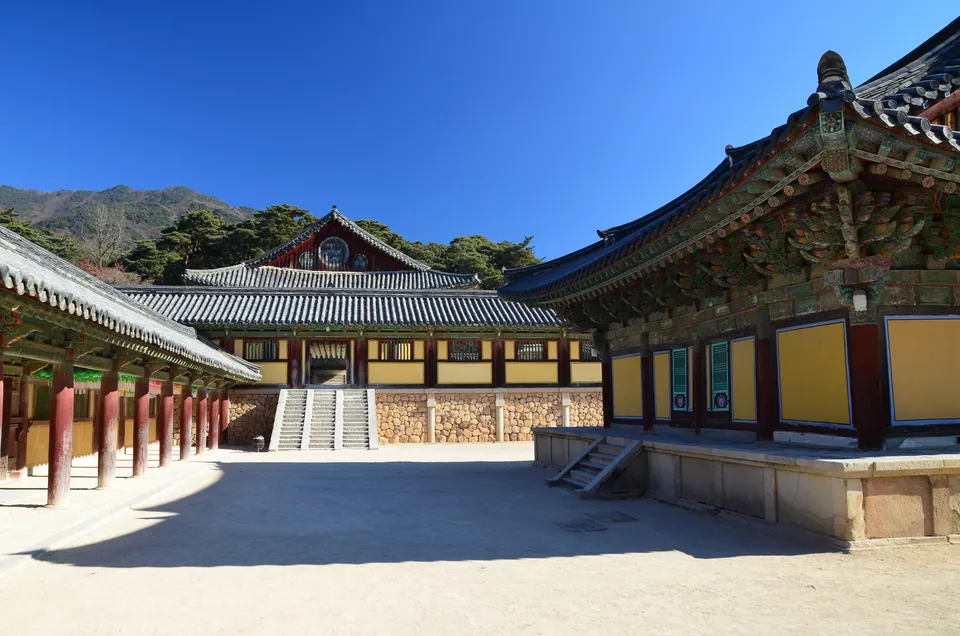
- Beomeosa (Busan) — a majestic mountain temple on the slopes of Geumjeongsan, easy to combine with a Busan coastal programme or a cruise call. Strong overnight immersion with a genuine mountain-monastery atmosphere close to a major city.
- Haeinsa (Gayasan) — home of the Tripitaka Koreana, the 80,000+ woodblocks of the Buddhist canon and a UNESCO World Heritage treasure. The obvious heritage-and-templestay flagship for cultural groups, best paired with Daegu or Gyeongju.
- Golgulsa (near Gyeongju) — the home of Sunmudo, a Buddhist martial-meditation art. Its templestay adds dynamic mind-body training to the usual chanting and meditation, making it a favourite for younger, active and team-building groups.
- Naksansa (Yangyang, East Sea coast) — a rare seaside temple where dawn meditation looks out over the sunrise on the ocean. Perfect for a Gangwon or Seoraksan routing and for groups who want the coastal-wellness angle.
Cultural etiquette prep: how the DMC briefs your clients
A temple stay only lands well if the group arrives prepared. Explera issues a pre-arrival etiquette brief in the group's language so no one is caught out, and our on-site interpreter reinforces it at orientation. The essentials we cover:
- Dress — temple uniforms are provided and must be worn during the programme; underneath, guests need modest clothing (shoulders and knees covered) and easy slip-on shoes, since footwear is removed before entering halls.
- Silence zones — meditation halls, the dawn service and the balwoo gongyang meal are kept in silence; we explain hapjang (the palms-together bow of greeting) and when phones must be off.
- Photography — generally fine in courtyards, restricted or forbidden inside halls and during services; the interpreter signals exactly when cameras go away.
- Conduct — no alcohol, meat, loud voices or pointing feet at the Buddha; guests are asked to follow the monk's cues and to eat only what they take at the monastic meal.
Because the brief goes out before departure, tour leaders spend the visit enjoying the experience rather than managing avoidable friction.
Seasonal hooks and pairings that lift the sell
- Lotus Lantern Festival (Yeon Deung Hoe), around Buddha's Birthday in May — temples nationwide are dressed in tens of thousands of lanterns and Seoul hosts a UNESCO-listed lantern parade. A May templestay tied to the festival is one of the most photogenic products in the Korean calendar and books early.
- Autumn foliage temples (late October–November) — mountain monasteries such as Beomeosa, Haeinsa and Naksansa sit inside the country's best maple-and-ginkgo scenery, letting you sell heritage and foliage in a single stop.
- Pair with Gyeongju heritage — the "museum without walls" and its Silla-era Buddhist sites (Bulguksa, Seokguram) combine naturally with a Golgulsa or Haeinsa templestay for a deep culture routing.
- Pair with wellness & spa — bookend a templestay with hot-spring resorts, forest healing and jimjilbang for a full mind-body-recovery itinerary that premium wellness buyers pay up for.
Practical planning notes for groups
- Capacity limits — each temple caps overnight numbers by its dormitory and hall size; large groups may need to split across two temples or two dates, or shift to the half-day format. Book allotments early for May and autumn.
- Gender-separated dorms — overnight accommodation is simple, shared and separated by gender (ondol floor-heated rooms with bedding on the floor); couples and families are briefed on this in advance.
- Monastic vegan meals — temple food is fully plant-based and excludes the five pungent vegetables, so it is naturally vegan and light. It also suits many dietary requests; flag halal-friendly and allergy needs at contracting.
- Accessibility caveats — mountain temples involve steps, slopes and floor-level living that don't suit limited-mobility travellers; for those groups we route to city temples (Jogyesa, Bongeunsa) or a half-day format with seated options.
- Pacing — the pre-dawn wake-up is real; schedule a lighter morning after an overnight templestay and avoid stacking it against a long-drive day.
B2B net rates and Explera support
Explera DMC Korea operates temple stay and Buddhist heritage programmes for the trade as clean, quotable modules:
- Pre-blocked temple allotments for peak windows — Buddha's Birthday / Lotus Lantern season and autumn foliage — held so your group has confirmed space before you sell
- Multilingual cultural interpreters in English, Spanish, French, German, Portuguese, Arabic, Japanese, Chinese and Russian to bridge the monastic programme for your guests
- Net rates on half-day and overnight formats that drop into any existing Korea itinerary without re-costing the base program
- Pre-arrival etiquette briefs in the group's language, plus coach transfers, licensed guides and full ground handling to and from the temple
- 24/7 operations support for every departure, from first pickup to the last hotel drop
IATA: 96215733 | Email: b2b@explera.kr | WhatsApp: +66 93 656 8090
Request temple stay net rates at b2b.expleradmc.com or contact the trade desk — send your group size, preferred temple or region and travel dates, and our team returns a priced templestay module within one business day.