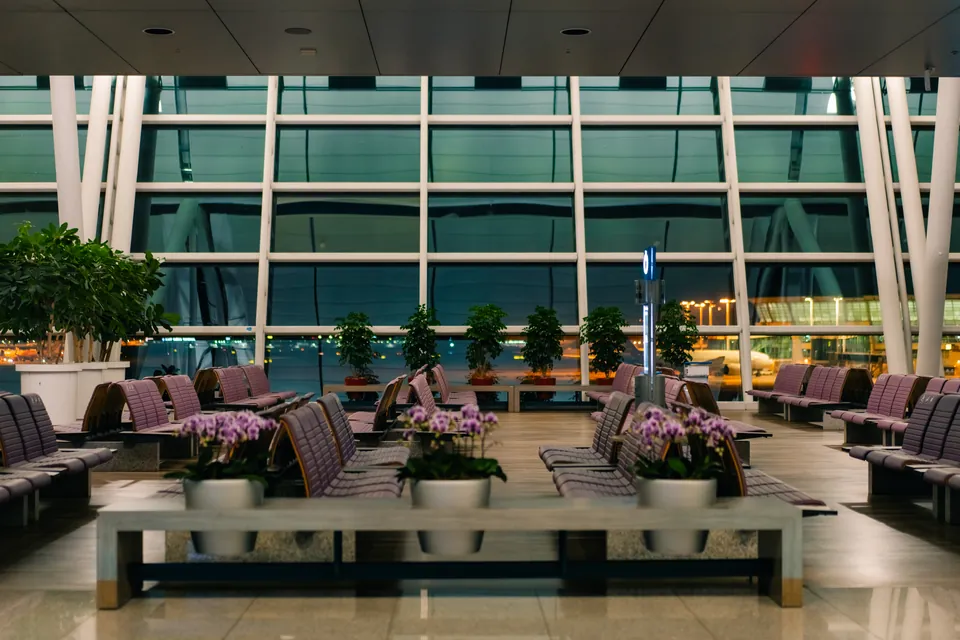

Quick answer: Most Korea group programmes are quoted as Seoul hotels with an Incheon transfer at each end, and the transfer quietly eats the two days it touches. That is no longer the only shape available. Yeongjong Island, immediately beside Incheon International Airport, now carries large-group venue supply of its own: the INSPIRE Entertainment Resort has 1,275 keys, an arena stated at up to 15,000 depending on configuration, and a grand ballroom trade press reports at 12,000 square metres holding 4,000 people. For a plenary, an awards night or an arrival-day reception that is a genuinely different proposition, because the group never leaves the airport's own island. It is not a replacement for Seoul — an airport campus is an hour from the content clients actually came for, and the AREX non-stop is about 43 minutes from Terminal 1 and about 51 from Terminal 2. Explera DMC Korea quotes both shapes and is direct about which parts of a programme each one costs you.
What is actually there now
- Yeongjong Island sits immediately west of Incheon International Airport and is where the airport-adjacent resort supply has been built. A group landing there is at its venue without entering Seoul at all.
- The INSPIRE Entertainment Resort carries 1,275 rooms, suites and villas. That is single-property inventory at a scale most Korean cities need three hotels to reach, which removes the rooming-list split that breaks a large incentive.
- Its arena is stated at up to 15,000 depending on configuration, with the stage reconfigurable between layouts. For a general session, a concert-format awards night or a product launch, that is a scale Korea previously answered only with a stadium or a purpose-built exhibition hall.
- The grand ballroom is reported by trade press at 12,000 square metres, holding 4,000. Take the room count and the set-up plan from the venue for your own dates rather than from any published figure, including this one.
- The regional congress centres are a separate answer, not a competing one. BEXCO, Songdo Convensia and EXCO serve a different brief, and our guide to Korea's convention cities sets out which is genuinely for what.
- Confirm availability before it is in any quotation. Single-property large-group inventory is exactly the inventory that goes to one buyer for a whole week.
The two days a transfer quietly costs you
Arrival day is usually written off before it starts
A long-haul group lands, waits for the last bag, boards a coach and reaches central Seoul an hour or more later, fighting whatever the road is doing. By the time rooms are ready the afternoon is gone. Quote that day as a programme day and you are selling something the client will not receive.
Departure day is the same problem in reverse
A morning flight means a pre-dawn coach call from the city, so the last night is not a night anyone uses. An airport-side property turns that into breakfast and a walk, which is the single most visible improvement a large group notices.
The rail is fast; the coach is the variable
AREX non-stop runs about 43 minutes from Terminal 1 and about 51 from Terminal 2 to Seoul Station. That is the best case and it is not how 300 people with checked bags move. A coach is slower, and how much slower is not something anyone can promise you in advance.
Being at the airport also strands you from the content
Everything a client flew to Korea to see is in Seoul or beyond it. An airport campus that saves you two half-days costs you an hour in each direction on every day you leave it. That is the trade, and it is a real one.
Which briefs the airport side actually suits
- A single-venue congress or general session, where the delegates are in one room for most of the programme and the city is incidental.
- Short-format incentives of two or three nights, where two recovered half-days are a large share of the whole trip.
- Arrival and departure bookends around a Seoul programme. First and last nights at the airport, the middle in the city — one coach movement instead of two, and no dawn call on the last morning.
- Groups arriving on many different flights across a long window, where a hotel you can walk to removes the staged-transfer problem entirely.
- Awards nights and launches that need an arena rather than a ballroom, which is a narrow requirement Korea has not had many answers to.
- Not a cultural or sightseeing brief. If the programme is Gyeongbokgung, the DMZ and a night market, the group belongs in the city and the transfer is simply part of the cost.
What to establish before you quote it
- Ask which terminal the group's flights use. Terminal 1 and Terminal 2 are not the same walk, the same shuttle or the same rail time, and a mixed-terminal group needs both answered.
- Get the venue's own capacity for your set-up, in writing. A banquet number, a theatre number and a cabaret number are three different rooms, and a headline capacity is the largest of them.
- Price the excursions as full-day movements. From the airport side every Seoul activity carries an hour each way, so a half-day city tour is not a half day.
- Check what the group can walk to in the evening. An airport campus is not a neighbourhood; free evenings need programming rather than pointing at a street.
- Confirm the airport-shuttle frequency and its last service. A group that disperses at its own pace needs this and nobody asks until someone is stranded.
- Decide the bookend question early. Splitting a programme across two hotels is a rooming-list and a luggage job, and it is worth it only if the days saved are days you were going to sell.
Quoted and operated on Korean ground time
Explera DMC Korea quotes the airport-side shape and the Seoul shape against the same brief and shows you what each one costs in programme hours rather than only in room nights: terminal-specific meet-and-greet for mixed arrivals; venue capacity confirmed for your actual set-up rather than a published headline; excursion timings built from the airport side rather than copied from a Seoul itinerary; bookend splits handled as one luggage and rooming movement; shuttle and rail options briefed to the group before anyone is standing outside with a suitcase; and a 24/7 operations desk on Korean ground time for the morning a flight moves.
Send the brief, the dates, the pax and the flight pattern to b2b@explera.kr or WhatsApp +66 93 656 8090. Explera DMC Korea is IATA TIDS-registered (96215733) and an ASTA member (#900408341); our KTO and KATA registrations are in application.
Where this fits in our Korea programmes
The pages below carry the operational detail behind this briefing.
- Services: Group travel & GIT in Korea · Transportation & coaches in Korea · Tours & activities in Korea
- Destinations: Incheon · Seoul · Busan